In November 2025, Strategy& — the consultancy arm of PwC — published a report called The Imagination Economy: Redefining value and human potential. It opens with a sentence I would happily have written myself: “The next economy won't run on carbon, data, or efficiency. It will run on the ability to imagine things that don't yet exist and the ingenuity to make them real.”
I read it the way you read anything published under a title you have been using for a year. Carefully, and slightly defensively.
What I found was not a rival account. It was a description — five “frontiers” where imagination might be applied, a proposed measure called Gross Imagination Product, and a closing question about who imagines the future first. It names a mood with real conviction. What it does not contain, anywhere, is an explanation of why imagination should have become scarce, or what changed to make it so.
That absence turned out to be the interesting part. Because it is not new, and it is not theirs.
Nineteen years earlier
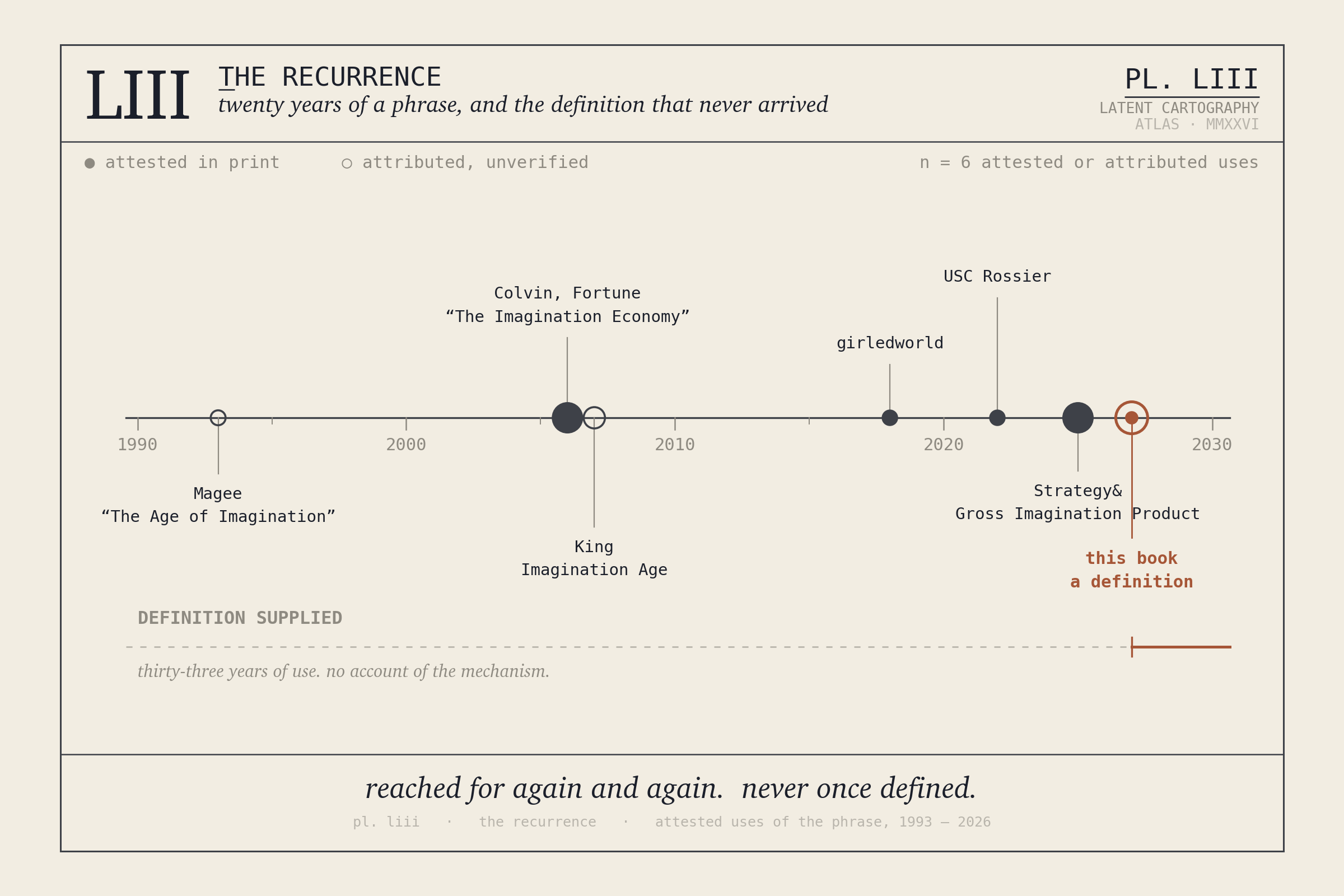
The earliest use of the phrase I have been able to find in print is Geoffrey Colvin's essay The Imagination Economy, published in Fortune on 5 July 2006. Colvin did not claim to have coined it. He used it as a headline for arguments then being made by Daniel Pink, Richard Florida and Virginia Postrel: that “the very basis of value creation is shifting from the disciplines of logic and linear thinking to the intuitive, nonlinear processes of creativity and imagination.”
Read that sentence again with 2026 eyes. It is almost exactly the Strategy& sentence, nineteen years earlier, with the nouns changed.
A parallel literature formed around an adjacent term, Imagination Age — introduced by the designer Charlie Magee in 1993 and popularised from 2007 onward, chiefly by the cultural critic Rita J. King. That term is frequently conflated with this one and should not be. An age is a period, named for its dominant character. An economy is a structure, named for its scarce input. The first describes an atmosphere. The second makes claims about where value accrues, and why.
Between those poles the phrase kept surfacing. A 2018 post on creativity as currency. A piece from the USC Rossier School of Education. Cultural criticism, marketing decks, conference titles. Almost none of these cite each other. There is no citation trail, no founding text, no argument anybody is building on. Just the same three words, reached for independently, by people who did not know the others had reached for them.
What recurrence proves, and what it also proves
Thirty-three years of independent recurrence, accelerating, and now institutional enough that a Big Four consultancy publishes under the title. That proves something real. People do not keep reaching for the same phrase by accident. They reach for it because they can feel a thing that has no name yet, and this is the nearest available set of words.
But it proves a second thing, and the second thing is less flattering to everyone who has used it, including me.
If a phrase can recur for three decades without accumulating a definition, it is because nobody has needed one. And nobody has needed one because every use so far has made the same undemanding claim: that imagination becomes more valuable.
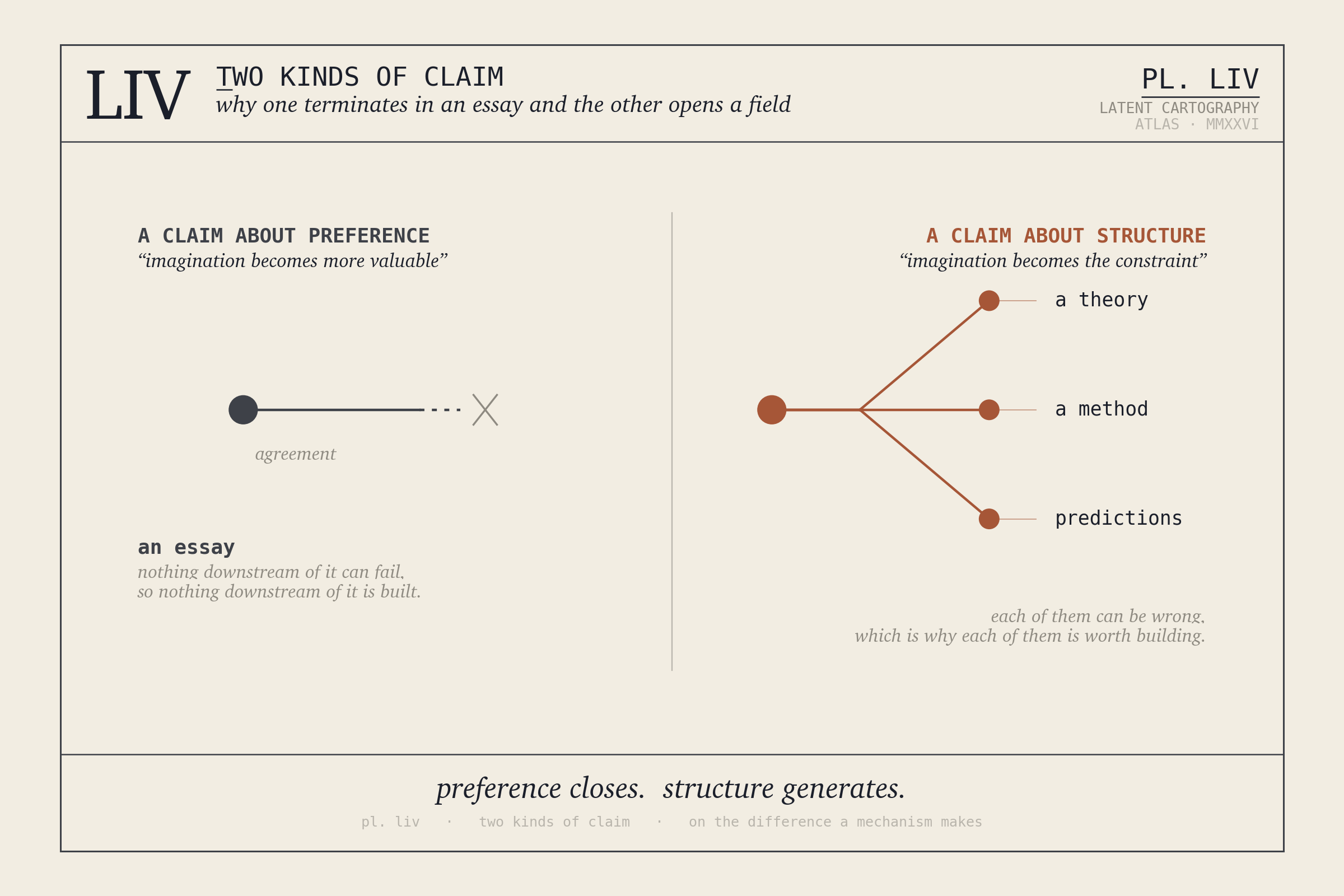
Notice what that claim asks of you. Nothing. You can agree with it over coffee and change no decision as a result. It cannot be tested, because there is no mechanism in it — no account of what made imagination more valuable, no threshold, no prediction that could come out wrong. It is a claim about preference. Claims about preference produce essays, and for twenty years that is exactly what this one has produced: a long series of thoughtful pieces, none of which needed the previous ones.
The other kind of claim
Here is the version I think is true, and it is a different kind of statement.
Imagination does not become more valuable. Imagination becomes the constraint — the binding bottleneck on the production of value — because the cost of making collapsed and the cost of knowing what to make did not.
That is a claim about structure, and structure behaves differently from preference. It has a cause you can point to and date. It has a mechanism you can describe. It generates predictions that can fail: that returns will concentrate among people who specify well rather than execute well; that the disciplines of specification are separable and teachable; that organisations optimising for execution capacity are optimising for something that stopped being scarce.
Any of those could turn out to be wrong. That is the point. A claim you cannot lose is a claim nobody needs to win.
Where 2006 was wrong
There is one more thing in the Colvin piece worth sitting with, and it is the part that has aged strangely.
The 2006 thesis expected logic and linear execution to be automated — the routine cognitive work, the offshorable work — while creative work stayed human and therefore became the premium. Design, storytelling, empathy, synthesis: safe harbour.
That is not what happened. Generative systems automated the making, creative execution very much included. The image, the draft, the score, the render, the prototype. The safe harbour turned out to be the first thing underwater.
So 2006 was right about the destination and wrong about the road. Imagination did become the thing that matters — but not because creative execution was protected. Because creative execution was the part that fell.
That inversion is not a footnote. It is why the earlier accounts could not produce a method: they were describing a world in which the human contribution was still making the thing well. Once making is free, the human contribution moves upstream to deciding what should exist — and that is a different skill, with different components, which almost nothing currently teaches.
What this site is for
I am not claiming the phrase. Colvin got there in 2006, Magee was circling it in 1993, and Strategy& will not be the last to publish under it.
What I am claiming is narrower and, I think, more useful: that in thirty-three years of use nobody has supplied the mechanism, and that without a mechanism the phrase cannot do any work. So this site is an attempt to supply one — a definition, the methods that follow from it, the history laid out properly so the next person does not have to reconstruct it, and the evidence as I gather it.
If the definition is wrong, it should be possible to show that. That is the whole difference between this and an essay.