What Is the Imagination Economy?
The Imagination Economy describes a world in which:
- Ideas matter more than execution
- Meaning matters more than efficiency
- Futures are imagined before they are optimized
- Narratives coordinate behavior under uncertainty
It builds on insights from:
- economics
- cognitive science
- cultural theory
- technology and platform design
What happens when imagination becomes the main economic input?
The Imagination Machine
A recursive, incentive-driven system that transforms individual imagination into collective value.

What You're Seeing
This diagram maps the complete cycle of how imagination creates value. At its center sits the imagination machine — the engine that converts individual creative sparks into shared economic and social capital.
1. Generation & Framing
Individual imagination begins here. Ideas emerge (1a/ Generation) and are given shape through interpretation and sense-making (1b/ Framing). This is where creative empowerment lives.
2. Shared Narratives
Individual ideas become collective imagination through alignment and shared sense-making. This builds social capital — the network of meaning that connects people around common futures.
3. Artifacts & Attention
Imagination becomes tangible — expressed as creations that attract attention and create ownership. This is where economic value crystallizes.
4. Cognitive Infrastructure
Adaptive AI systems amplify imagination and create recursive intelligence — feeding insights back into the cycle. This is the structural power layer.
System Tensions
The warning markers around the wheel highlight where value can be lost: misalignment between individual and collective goals, asymmetry in who captures value, and drop-offs & friction that prevent ideas from completing the cycle.


Why This Matters Now
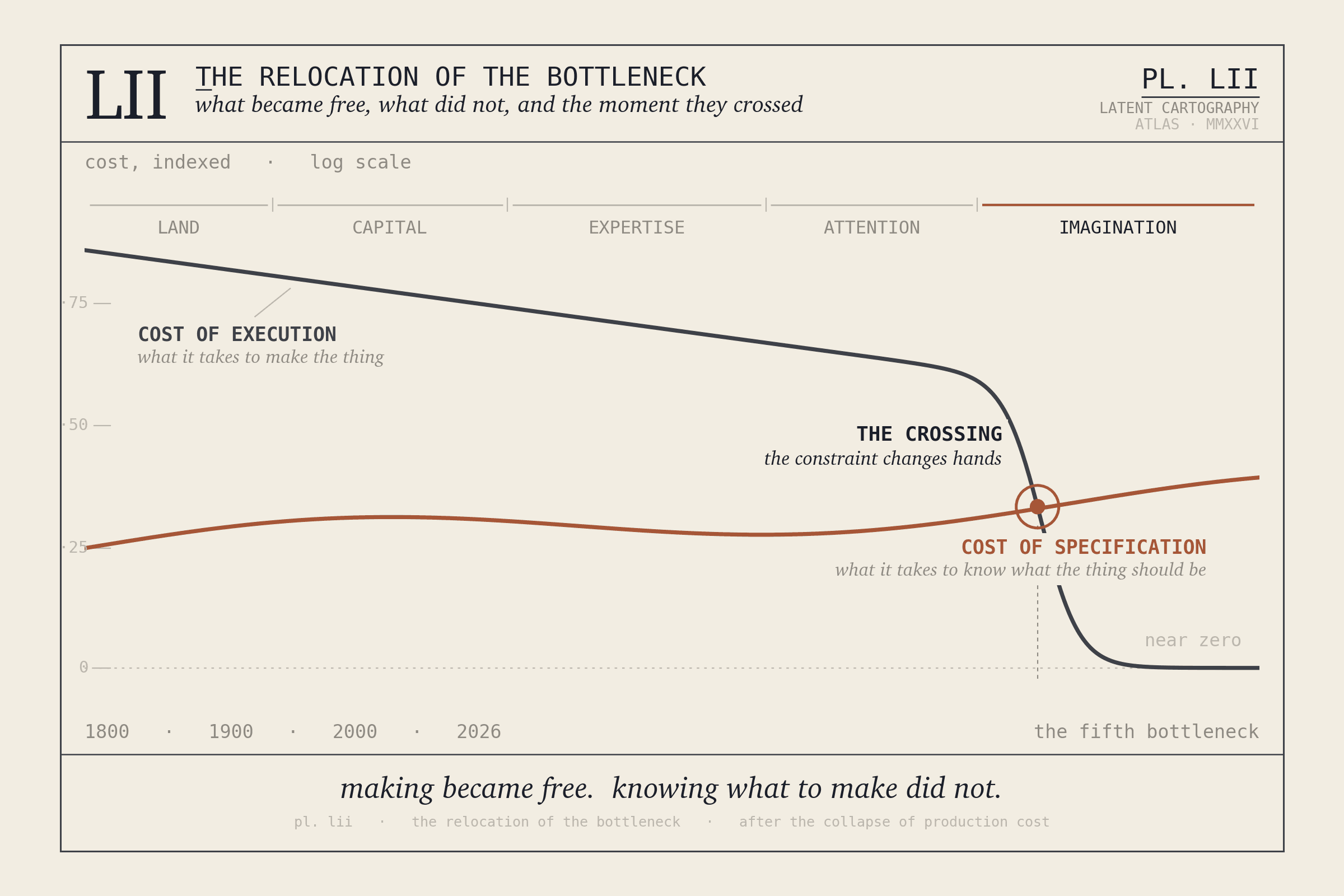
Generative AI has fundamentally changed the economics of creation.
- Text, images, audio, and video can be produced at near-zero cost
- Technical quality converges quickly
- Output abundance no longer creates differentiation
In this environment:
- Attention alone is insufficient
- Novelty decays instantly
- Value shifts toward durable meaning
The Imagination Economy is about what survives when everything can be generated.
Compelling Imagination (Not Just Novelty)
Not all imagination creates value.
Clever, shocking, or dystopian ideas may attract attention — but they rarely invite inhabitation.
In the Imagination Economy, value comes from worlds that are:
- Desirable — people want to live there
- Inhabitable — people can see themselves inside
- Open-ended — people want to continue them
- Shareable — people want to extend them with others
Examples of compelling imagination include:
- experiencing a life you didn't choose
- living in a place designed for human well-being
- starting over without being defined by your past
- meeting your future self once
- rethinking reputation, identity, and belonging
These are not prompts.
They are worlds.

A Simple Value Model
In the Imagination Economy, value is not additive.
It is multiplicative.
- Imagination
Can people project themselves into this future? - Narrative
Can others meaningfully continue and reinterpret it? - Discovery
Can it be found, remembered, and returned to?
If any one of these approaches zero, value collapses.

Platforms as Imagination Infrastructure
Platforms do not merely distribute content.
They decide:
- which ideas become visible
- which futures feel plausible
- which narratives gain momentum
In this sense, platforms are imagination infrastructure.
They allocate:
- attention
- legitimacy
- continuity
Understanding this role is critical — culturally, economically, and ethically.
From Theory to Practice
The Imagination Economy is not just a concept.
It informs:
- how platforms should be designed
- how discovery systems should work
- how creators should be supported
- how value should be measured
One concrete instantiation of these ideas is Craisee — a platform built around persistent worlds, continuation, and shared imagination.
But the Imagination Economy is larger than any single product.
What You'll Find Here
This site is a living knowledge space.
Over time, it will include:
- foundational essays
- research references
- conceptual models
- examples of compelling imagination
- case studies of platforms and practices
- vocabulary for thinking about imagination as an economic force
It is intended for:
- builders
- researchers
- creators
- designers
- strategists
- anyone thinking seriously about the future of value
A Guiding Question
As creation becomes effortless, a different question matters more:
The Imagination Economy begins there.